 Justin and Heidi Dierking started trying to have children within months after they were married in 2004. At 32, Heidi married late (typical of many modern women) and knew that her body was in the late stages of its reproductive capabilities.
Still childless two years later, the Dierkings began medical tests, which failed to uncover any problems. The fertility drug Clomid didn’t help. Finally, with the clock ticking, they sought help from the Center for Reproductive Medicine in Minneapolis, a clinic that is part of an estimated $3 billion fertility industry in the US, many specializing in in vitro fertilization (IVF).
IVF is a procedure in which sperm and eggs are combined in a petri dish and incubated in an environment favorable to reproduction. Once evidence of cell division is seen, the two healthiest blastocysts are carefully implanted into the woman’s uterus where, if all goes well, they will attach and grow.
The procedure seems to have worked for the Dierkings; doctors harvested her eggs, combined them with her husband’s sperm, and Heidi Dierking is now pregnant and expecting twins.
(The Minneapolis Star-Tribune’s Chen May Yee and Josephine Marcotty have written an excellent series of articles on the fertility industry titled Miracles for Sale. Read these stories here, here and here. Free registration is required.)
IVF has made headlines because it has been used by single women and lesbian couples to conceive children outside of the normal confines of a marital relationship. But it is also becoming the accepted treatment of last resort for any couple who can’t conceive children normally — the procedure is accepted enough to be covered by many insurance policies.
Most IVF clinics advertise 50% success rates, and competition has forced many to offer money-back guarantees if the expensive treatment doesn’t result in a viable pregnancy.
Christian ethicists are trouble by IVF. In this explanation of Catholic teaching, IVF is called gravely evil, very strong words for what seems on the surface to be a medical procedure offering hope to childless couples.
1
Samuel 1 tells the touching story of Hannah, wife of Elkanah, who was tortured by her inability to have a child. Her husband loved her deeply, but Hannah still felt the grief and social stigma of her barrenness.
Hannah prayed and God answered by giving her a son, Samuel, who became an important priest in Israel.
Modern science — not having much patience with prayer — has learned many of the secrets of reproduction and has put that knowledge to work. IVF and many other fertility techniques pose ethical problems, however.
Multiple embryos are created in many of these techniques, requiring what is euphemistically called “selective reduction” or the intentional abortion of “extra” embryos, leaving only one or two to be carried to term. IVF tries to better the odds of creating a viable embryo by fertilizing a great number of eggs simultaneously. The most healthy are chosen for implantation while the others are frozen for possible later use, or destroyed outright.
Biologically, a human embryo is a living human being at its earliest stage of development. The embryo is dependent on a woman for nurture and life, but it is a genetically distinct organism, different from both the egg and sperm that it grew from, and it needs nothing more than nourishment to grow into a recognizable human being — a point on which both science and Christianity agree.
Therefore, Christians argue that the destruction of embryos in the IVF process requires the destruction of human life in order to create human life.
Just as troubling is the fact that IVF encourages the commoditization of human life. Young women, many of them single and in need of cash, are signing up on websites like Egg Donation, Inc., where they post photos of themselves next to their personal profiles, offering their eggs for cash. Typical profiles include details about their likes and dislikes, their ethnic background and their educational level and talents, in addition to such basic facts as height, weight and hair color. Egg purchasers are encouraged to browse the site in search of the perfect set of qualities for the child they hope to bear.
The Star-Tribune series profiled Caitlin, a young Canadian artist who received $6,000 for her first egg “donation” and $8,000 for a second one, both to women whose own eggs were no longer viable.
Caitlin was drawn to egg donation by the realization that her eggs were going to waste with every menstrual cycle. “I think it’s great,” she said. “Men have always been able to spread their genes. Now I can spread my genes.”
Caitlin obviously got A’s in her evolutionary biology classes.
Where does it take us as a society if the buying and selling of human life becomes normal? What will be the emotional impact on children who are conceived in a petri dish, especially those created from eggs and sperm purchased on the Internet? Will they come to see themselves as scientific freaks?
IVF already allows doctors to do genetic testing prior to implantation. Sex selection is possible, and with further technical refinements genetic “enhancements” might become an option. Will parents someday have the ability to select genes for intelligence, for artistic talent, or for beauty?
Will parents who pay big bucks for a quality embryo badger their children harder to achieve greatness? Will such a parent lose affection for her child if she turns out to be just your average, ordinary underachiever? (Can you sue an egg donor for product liability if your IVF child drops out of college?)
What we risk in this brave new world of human reproduction technology is the diminishment of human dignity. Christianity clearly teaches that every human being is the unique and precious creation of God, an individual whom God loves, an individual for whom God has specific plans and hopes, an individual for whom Christ sacrificed himself on the cross.
In the Christian view, we inherit our human dignity and worth from God, the author and creator of all life.
If we use our human genius to manufacture children in laboratories, if we purchase them on American Express and select them genetically like a Baskin-Robbins’ flavor-of-the-month, we inevitably demean human beings and the intrinsic value of all life, in the process.
Hannah’s childlessness grieved her terribly. As the father of two children, I understand something of that grief: my children have brought me immeasurable joy. If the church calls IVF a “great evil,” it puts itself in the wretched position of labeling infertile women who turn to IVF “great evil-doers.” The church must show these women Christ-like compassion and real help with their pain.
At the same time, the risks to society and human dignity posed by IVF and other such fertility technologies is enormous. We cannot let our compassion for childless women cause us to fail to take a hard look at the ethical implications of this new science. Science is in the business of pushing back the frontiers of knowledge. The church has to serve as science’s conscience and the guardian of human dignity.
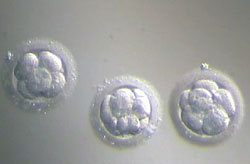
Photo credit: 3-day-old embryos created by IVF, from Sir Ganga Ram Hospital Centre of IVF and Human Reproduction.


I too am extremely disturbed by IVF. Aside from all of the excellent moral issues you discuss in this post, I am concerned about the emphasis placed on biological children. Certainly it must be painful to discover that you cannot have a child, and there must be a grieving process. But there are so many children in the world who do not have families, and who could be adopted for a lesser monetary and physical cost than IVF conception. People go through multiple IVF cycles, draining their bank accounts (and in an age where many IVF couples are older, this often represents a depletion of retirement savings) and, in many cases, still do not conceive. I believe infertility is perhaps a little nudge to examine other options for parenting.
Interesting, Charlie! I will take some time to respond tomorrow. And to “Glitch” I would ask only one question…what is your personal experience with IVF and adoption? I mean no disrespect, but your comment came across as being from a man with many opinions, but not much factual knowledge on either subject.
I’m not going to get into the morality issues since no one can know what we go through and no one should be in a positon to tell us what to go through. We are all very clever when it comes to using the bible to justify our own opinions. But I am hoping someone might be familiar with a new fertility retreat center in Hawaii.
Called the KaNeCa Fertility Institute. Thanks – Mat
I don’t think anyone would disagree that the creation of human life (from sperm and egg) is wrong…but rather it’s destruction.
Sadly, so long as abortion stays legal in this country, I’m afraid any arguments about the unethicalness of embryo destruction will continue to fall on deaf ears in certain segments of the medical community.
All couples going through the IVF process have choices regarding the implantation and subsequent treatment and/or destruction of all embryos that are created. The clinics do not make these decisions, the patients do. However, many patients are unaware of how much power they really do have in this area.
To say that couples should not pursue IVF as an option to have a child because embryos might be destroyed in the process is the same logic as saying a man should not have bypass surgery because he may live to be an ax-murderer in the future. Both medical procedures would appear to be interfering with what *some other human being* feels is God’s will for the life of another person.
I don’t mean to sound flippant, but there is a lot of substance to this whole topic that I do not believe is as black and white as we’d like it to be. But I will say this – like Charlie, it is the destruction of embryos that I have an issue with, as well as the less-than-honest doctors and clinics out there who try to steer already emotionally-burdened couples into life and death decisions they may not feel they have any control over.
I also view it as complete silliness when anyone suggests that I am not submitting to God’s will for my life because I chose IVF. I hope this discussion remains focused on biblical ethics, as I want to remain open to all knowledge on the subject.
Excellent comments, Kim. I’m especially encouraged to hear you say that couples have a great deal of control over their medical choices in the IVF process. I’m confident that there are some good doctors out there, too, who will respect the patient’s ethical concerns. Thanks for adding your insider’s view of this emotional subject.
Nope, not a man, not that I feel my gender has anything to do with my right to hold opinions. Which is what we all have. I’m sorry if my comments brushed you the wrong way. I don’t think it’s wrong or evil to go through IVF. But I have known several couples who did several cycles and ended up still not pregnant, just a lot poorer. That combined with the fact that there are many children waiting for adoption in the world makes me a little wary about the casual attitudes some people have about IVF.
We are currently pregnant from an IVF. I don’t have any guilt at all about the fact that we did not choose adoption.
All this talk about ‘dignity’…yet you would say to couples with a medical problem, who use a medical treatment, that they are “manufacture[ing] children in laboratories”. That is disrespectful in my view. IVF children are not “manufactured”. They are grown in their mothers womb, after medical treatment that involved a medical facility to assist in the process of conception. Would you say to a heart transplant patient, that they were “ripped open and put together like Frankenstein”? I suspect you would show respect for them and the medical procedure the endured, not disrespect them by demeaning their medical treatment and make it sound like their was no “human dignity” in their treatment. How insidious and easy it can be manipulate language to further an agenda.
And to Glitch. I found your comments to be the most interesting of all. Of course there is an emphasis on biology. That is as natural as being human. Our bodies are designed to procreate. The experience of pregnancy and shared bond of creating a new life is a central part of life for the majority of people. In most cultures we celebrate the family, we celebrate our lineages, and shared physical characteristics as a natural part of life (the baby has his dad’s eyes, she has her mother’s sense of humor, she looks like great aunt Edna!, you look just like your sister…he is passing on our family name) and on and on.
As for adoption, they are two rather distinct issues that are too often put together to equate a problem=solution. Adoption does not address all the losses associated with infertility as if it were a fix for infertility. Adoption in not right for everyone either. And as for the idea that adoption is cheaper than fertility treatments. Think again. While it can be free, it often is just as much or more, it is also invasive and complicated, and can take considerable longer than medical treatment with no guarantees either. I hope you equally suggest that “fertile” couples adopt the children of the world that don’t have families, and are not suggesting that infertile couples are more responsible than others to adopt needy children because they have a medical problem with their reproductive system. I was most amused though by the suggestion that you “believe infertility is perhaps a little nudge to examine other options for parenting.” Imagine saying something similar to someone dealing with a different medical problem. Something like there is a “reason” they are afflicted with a medical problem, and that they should take it as some sort of ‘sign” they are not destined to be “healthy”, “walk”, etc.. I suspect you wouldn’t likely see things that way in their cases.
Hi, i a woman how have taking care of my sibiling all my life so i thank i have already adopted some kids and i thank it is my god giving right to have kids of my own .
i have seven children masha-allah i’m prode that allah (god) has given children. everyday when i pray i thank god for giving and allowing me to have childre. there some women that can not have babies and there are some women that don’t want to have children, these women that don’t want to have children are thinking they have choices either to have children or not, but they are wrong because, i personally believe that god allowed you to have children and why waste this chance, you could die not having childre and when you see women with children you will feel guilty and believe me you would wish you had children. having children is a blessing thing god gives an individal so don’t loss you chance of having children.
I have a child thru ivf. I love my daughter deeply, however feel I have grieved the Lord by not praying and waiting on His decision. Having a child became my idol. I would encourage anyone pursuing ivf to pursue God first. This was my mistake.
Emma, you’re the only person who has made a sensible comment so far…
Thank you for your very honest comment. I would say that you are right that we all need to seek God first. We don’t know if IVF grieves God. It may, indeed, as many things we do grieve Him, despite our best intentions. You now have a daughter whom you love dearly, and whom God loves dearly. In Jesus, God treats us with grace and forgiveness. I hope you will look ahead to how this wonderful gift God has given you will enrich your life and leave the past in the past.
Paul himself said he focused on one thing above all:
No, dear brothers and sisters, I have not achieved it, but I focus on this one thing: Forgetting the past and looking forward to what lies ahead, I press on to reach the end of the race and receive the heavenly prize for which God, through Christ Jesus, is calling us. Philippians 3:13-14
People who are commenting negative comments about IVF here, I will bet are people who don’t have a problem conceiving a child. I am 39 years old, 3 IVF cycles and childless. I am currently going thru an IVF process again and I am looking forward to it. I had 16 eggs retrieve which 9 fertized to an embryo stage. I had 3 put back to my womb and I am currently waiting for my pregnancy test. Who are you people to judge IVF? The IVF process has given me hope. Hope to see God’s recreation with the help of my doctor.
My husband and I are currently preparing to undergo an IVF cycle. As Christians, we felt it is our responsibility to approach this technology with the utmost caution. As a patient, one must fully be educated on what their rights are and aware that You have control over all decisions in the process, not the doctor or embryologist. If your doctor doesn’t respect that you are a Christian and will be placing certain restrictions to the cycle, then it would be best to find another doctor that will.
I actually had a doctor tell me that I could not dictate how many eggs were fertilized. How can that be when they are my eggs??? For both my husband and I, we did not feel we should fertilize more eggs than we were willing to have children. Whether we get pregnant from this cycle or not, we will be using ALL eggs that will be successfully fertilized. The option to discard is obviously not a viable option for Christians.
As far as adoption, we adopted our daughter almost 2 yrs. ago. What a blessing she is. For our family, the adoption was a long, expensive, unpredictable process that in all honesty we are reluctant to go through again, even though the outcome was greater than we could ever imagine. But the Lord has to put this calling on your heart. I would never judge anyone who would choose one over the other (adoption vs. IVF). In our case, we chose both and believe the Lord will guide us through each experience.
IVF is a miraculous process. Usually those against it have never struggled with medical issue’s causing infertility or they are hung up on religious dogma. And it should be noted that half of cases of infertility are due to male factor. Medical intervention helps countless couples complete the fertilitzation process. Some of these anti-IVF protesters hide behind their bible judging others..and probably taking Viagra and have no problem using modern medicine to help them sexually. What’s the big deal if a man’s sperm need’s a little help to penetrate and egg. Or if an ovary needs medicine to complete the process.
Religon and science dont always mix and people defend using it when its convenient for them and judge when it doesnt fit in their make believe perfect world bubble.
Here is my dose of religion-God works in amazing ways and through all of us. He gave the talent to the reproductive enchronologists and embryologists to help loving couples (gay and straight) who cant conceive on their own spread love and joy in a judging mean world. I love when super Christians act holier than thou as and spend so much time judging people. Go on a mission and help people and stop waisting everyone’s time rambling on about IVF,abortion, homosexuality and stem cell research. We have plenty of doctors and scientists doing plenty of good work-go find something else to make yourself useful.
Thanks for your comments. I’m glad you took the time to express yourself, but I’m disappointed in your attacks on religious people. You and I agree: Having a child *is* a miracle, and I’m always happy when people want to bring new children into the world and give them loving homes.
But IVF is not a miracle: It’s a human technology invented to solve a problem. And like all human technologies, it creates unintended consequences, risks, and moral problems.
Antibiotics are a great benefit, but the misuse of antibiotics has led to MRSA, a drug-resistant bacteria. Cars are a great benefit, but they pollute the air and kill thousands of people every year. We debate these things because life is precious.
IVF *is* a blessing to couples who can’t conceive on their own. The problem is that most fertility clinics destroy a great many embryos in the process of getting one to “take”. Embryos are human life. Granted, they are not the same as mature human beings.
But many people, myself included, think we need to be very cautious about how we respect human life at every stage: before birth, through maturity and at death.
If you disagree, I’d like to hear your reasons. But the name-calling gets us nowhere.
Come by again, Reegan. Your comments are always welcome.
I am a Christian, and definitely concerned with the ethics behind IVF. My husband and I have been trying to have children for 10 years. We have no medical explanation for not being able to do so. We have spent the last year or so in the process of an international adoption that will most likely NOT pan out and have lost several thousand dollars in the process. Trust me when I say that not only I, but a MULTITUDE of people have been praying for a child to come into our home. I absolutely feel that I have turned to God and have fervently listened for His direction.
We are in the middle of an IVF cycle right now. Last week, I transferred two embryos and this Thursday, I will find out if they implanted. We had 6 embryos that fertilized, and one that was not transferred was frozen, as it grew to a stage where it could be. Sadly, the other three did not, and I have mourned the loss of them, as they were lives at conception.
To me, the process I have gone through with IVF is one that many women actually have go through their bodies, and don’t even realize. It is VERY common for eggs to fertilize during a woman’s cycle, yet not be adequate enough to continue to grow, implant, or both. When this happens, the woman is rarely even aware of it. In my opinion, that is exactly what happened with our cycle–eggs were fertilized, they continued to grow, and I pray they implanted and will continue to grow–the initial process was simply not in my body, but out. We went into the cycle, and will continue to do so if this doesn’t work, with the intent to at some point, transfer each and every embryo that we have. Regardless of the number. We definitely discussed limitations as to numbers harvested, and embryos fertilized, but the bottom line is that the ability for an egg and sperm to join and become a distinct entity of its own is simply a miracle of God, no matter how it happens. Sadly, this can and does often happen “naturally” and yet pregnancy never occurs. The embryos that did not continue to grow most likely would not have grown inside of me either. Can I say for sure they wouldn’t? No, I can’t…but I can say that I have prayed and prayed over this all, and feel that if I am meant to have a biological child, it will be as a result of this procedure. I am thankful to God that the technology exists.
Yes I agree.
Best way to reduce greivance for childless couple is to adopt orphans. In that way you are not sinning by killing young lifes (embryos) and also you get children who can give you bondless joy. Also world should know that eating non-veg is a sin and killing animals is also a sin whether its a fish, bird or goat. Even animals are God’s creation and they too have emotions and family like a pet dog. Also science can never replace God, as we have seen all that scientists accomplish in most cases is create a monster. Example, in bio-engineering they created genetically modified seeds which in long run will cause diseases (God forbid). Also now organic foods are popular and we know benefits of organic foods. Basically anything natural (i.e. existing as God created it) is better than these so called scientist modified creations. In long run we will come to know that these IVF children will get some weird diseases (God forbid) and pass them down generations just like genetic modified foods have corrupted the food cycle in our nature. Scientists claim to create electricity which gives power and light but we know now that working under artifical light and under sunlight are two different things. Sunlight not only gives light but have many advantages to it. It is another thing that we destroyed ozone layer and now some sunlight at some places can be dangerous. Basically we need to follow the holy sciptures in word and soul and need to go back to basics of natural existence.
If I need a job, my first step as a Christian should be prayer, but am I doing wrong or going against God’s will if I supplement my prayer by sending out my resume and going to interviews?
If I want a house to live in, my first step should be prayer, but am I d oing wrong or going against God’s will if I supplement my prayer by saving up for a down payment, filling out a mortgage application, and hiring a realtor?
If I want a child, my first step should be prayer, but if after many years of being unable to conceive a child on my own, am I doing wrong if I supplement my prayer by getting medical treatment?
Actually, adoption is a lot more expensive than IVF and not really as available an option as presented by the commenters here.
Even if we adopt from Russia where you get a 2 to 3 year old who might have been exposed to alcohol poisoning, it costs minimum 20 – 40k.
Going through a reputable agency for domestic adoption, they want my husband and me to pay $40k b/c of our income bracket.
IVF costs b/t 12 and 15k.
It is simply not true that there are a ton of children waiting to be adopted and it is an easy thing to do. If it were true, we would definitely adopt.
I really encourage you to price out IVF and then adoption. If you want a baby with FAS or Cerebral palsy or any other health defects the cost is low. But if you want a healthy adoption you are looking at alomost the same cost as IVF.
Embryos are never ever destroyed on purpose without the patients permission so the notion of embryo destruction has no place in discussing IVF and Christianity. If you have a problem with an embryo not adhering to the womb during IVF, then you must be against trying naturally for a child as well. Every time you have uprotected sex you risk the life of an embryo– it’s just a fact of life that not all pregnancies will take. It’s actually not that uncommon. Then there is the issue of miscarriage.
I know a woman who had several before carrying a baby to term. Should she have stopped when she realized she was risking not just 8 celled embryos like in IVF, but a fetus? Should her precious child not be here because it was wrong to risk her previous siblings? Was it unethical to keep gambling?
I also know a women who had a beautiful child through IVF. Two embryos were implanted, one took. Only one embryo was lost in the pursuit of a child, unlike the 4 fetuses of the woman who tried naturally. Should this woman’s child not be here? Does that child not deserve to live? Without IVF she would’nt exist. It’s as simple as that.
Do you really think that if those tiny bundles of life could speak if they wouldn’t say, “Risk life!”
Just wondering if those who are against IVF are also against Vasectomies and contraceptives as well. From my research, with the exception of catholics, most christians don’t see anything wrong with preventing pregnancy, but have issues with medically advancing a woman’s chances of getting pregnant.
There are so many questions and opinions. Might I suggest the following for anyone with conflicting issues?
Catholics and IVF: A Pastoral Approach
Are you a Roman Catholic or married to one and considering IVF or other forms of ART for your family? Does the Roman Catholic Church’s position raise concerns regarding your decision?
Please join The American Fertility Association and Fr. Jon Pedigo on Monday, December 7th for a webinar which will address these important issues.
For More Information .
For more information, please email Corey at: Corey@TheAFA.org
There’s a word in biology called ‘Natural Selection’. Nature has its own basis for its choices,what, we may never know.If nature decides that a couple should be infertile,maybe sometimes we had just better accept her will.Infertility or sterility can be caused in numerous ways,even by fault of the person or persons concerned,(heavy drinking, drug addiction etc..)And then again there are the unexplained causes.Low sperm count,blocked fallopian tubes, low quality of sperm and/or egg are all responsible.
MTP (Medical Termination of Pregnancy) or simply abortion as we know it is sometimes required. I think, instead of raising stupid ethical questions,it’s better to just get rid of a child who is in any case unwanted and might be destined to leave an unhappy life. A child who has suppose some chromsomal abnormalities or isn’t viable,there’s no point in giving birth to them cause their life will be full of suffering. So Im fine with abortion being legal. But maybe IVF shouldn’t be.
This issue is very delicate and the debate will go on…
I read all the comments and am totally impressed by them.All coming from matured, sensible minds and maybe my opinion doesnt really count. Im but a 10th standard student doing a school project on IVF, my opinions not to be taken seriously and replied to harshly. But as I said before, Im against IVF. Against it because its a totally artificial process. I do realise that couples facing infertility problems look to IVF as an solution and why not if they can afford it. We need good genes, from good well to do families passed on as well.But the thing that I find really regressive in IVF is getting pregnant after menopause.We can do without women expanding their reproductive carriers, not heeding their biological clocks and putting both their baby’s and their own lives at stake.
I remember thinking that I would NEVER do IVF. I believed that God is the giver of life, and if he wanted to give us a child then he would in his perfect timing, and I was willing to wait on that. However after two miscarriages, four ectopic pregnancies, and three surgeries that ended in the removal of both of my tubes, I began to see things a little differently. You cannot imagine what it feels like to be a young woman and to know that you will can never have children on your own. It was then my husband and I started looking into the IVF process, which we will begin this month. I still believe with all my heart that God is the giver of life and he alone. The fertility doctor with all the knowledge that God has given him can manipulate certain factors, but ultimately it is God who allows life to grow or not. I have prayed and I have determined in my heart that if God wills it the IVF will work, and if not then he is still God and I will serve him.
thank you for you post – I hope God gave you a baby. My daughter is going through IVF and although I can’t express my concerns to her I feel such anguish about the embryos. Perhaps God did answer me when I found this site and posts from thoughtful Christians like yourself. I had forgotten what my doctor told me when I was pregnant – if the baby I was carrying wasn’t healthy my body would naturally miscarry. I will continue to pray that this baby will be a gift from God – as all children most certainly are.
I have been surfing the internet looking for others that struggle through the issue of IVF. For some of us it is the only option for conception. It is amazing to know there is an option out there that would allow people the blessing of their own child when it has never before been possible. It is a difficult situation when you know this option is out there, but in order to go through with it, you are potentially risking the premature death of your own children at the embryotic phase of development. In the end, the answers must be sought out from the creator of life Himself on whether or not it is moral and right.
Tim, that is our precise concern. Freezing isn’t an option, because we don’t like the extra risk to life it is to the embryos. Our clinic has excellent cryopreservation techniquies, with success rates only 10% less than with fresh embryos, but that’s too much for me.
But I’m still disturbed by the number of embryos that sometimes don’t make it, even with a fresh cycle. If we have 5 eggs, 4 might be fertilized, 2 might grow to day 5, and only one might implant. And that one might still miscarry. Searching the internet I see that of those embryos that fail to grow, there is a high number of genetic abnormalities. So it is assumed that they wouldn’t thrive naturally either. But how many deaths are due to less than ideal culturing? Can we ever even know? This is the part that disturbs me. I realized that I don’t want any embryos to die in the process, so we are thinking of attempting to fertilize only 3 eggs, understanding that not all eggs fertilize. But I realized that I’m asking God to defy the odds and let all the embryos live. How is that any different than my situation without IVF. Either way, I’m asking for a miracle.
Emma, i love your comment because I too am facing that choice. My husband and I just found out this past week that IVF is our only option. But we know that is only according to human efforts and all things are possible with Him. I few weeks before when I was having a breakdown (as i like to call them) I felt God look at me with such sorrow and sympathy for my pain, and could hear Him say “i’m not saying no, just not right now.” My husband and I are student ministers and I know we wouldn’t be able to do as much or be as much for our kids in the ministry if we had a child. What a difficult thing to accept when I see God’s will for our life (for the time being), and then must say in faith as Christ did “Not my will but they will be done.” Since we got those results we have felt God urging us to Ask, Seek, & Knock as Scripture says and we will do just that. I realize our situation is not everyone’s and I know each situation is immensely personal that each person has to walk through for themselves. Bless you that the Lord was able to speak to me so clearly through you. I don’t look down on you at all, but your story makes me not want to live with the regret of having overstepped God’s will for my life. Thank You.
ok whoa whoa whoa, back it up a little here people! i am only 16 and i am studying IVF vs the christians for a religion assignment, everyone needs to chill!
AS i am only 16 i would not know what it is like going through IVF or adoption, but my mother was adopted and it was not easy for the family. My cousin was born through IVF and yes the parents are christians *gasp*!!! There is nothing wrong with getting medical help such as IVF to conceive a child!
You say its against God, but God created these miracle workers who studied and did enough research, dedicating their time and life to people who cannot have children naturally.
To say that adoption is better and more holy then going through IVF is just plain bullocks!!! What is so much better about adopting a child (who by the way, the parents didnt want) then IVF? the process of IVf i say is better and more Holy as it is at least being grown in the mothers womb! it is their eggs, their sperm! they are just being fused together with the help of doctors.
It outrages me to read those comments saying it is wrong and against God! It is not, it is going through natural birth, just getting a little help with conceiving.
I myself suffer severe endometriosis and may not be able to concieve children when im older and married, and if so i would be considering IVF or surrogacy!
Thankyou for reading my opinions on this highly contraversial matter.
If you expect these infertile couples to adopt, do you understand the long extensive process this takes? I know a couple who have waited two years to be approved for adoption. They still haven’t had the opportunity to find their child yet. By the time a couple are ready to have children, they may spend a year trying before they discover they are infertile, and then maybe another half a year considering adoption. Once the decision is made they have to undergo the long and tedious process of being approved as a safe family, and then are out on the end of a waiting line before they find a child. Say the couple started trying at 25, they might be 30 before they received a child.
At least with IVF there is a natural birth from the mother, I believe it is the most convenient and natural option. Sure there are family less children all over the world, and they do deserve first priority, however the process to try and help these children is ridiculous. If there was a reform about the process adoption would be a much better option for families. But for now, I believe IVF is very necessary and safe.
umm.. your words exactly Kim- ‘I don’t think anyone would disagree that the creation of human life (from sperm and egg) is wrong’
As far as i know the only way to create human life is with an egg and a sperm? Why would this be wrong?
Thankyou, finally someone who makes sense 🙂
I just want to thank everyone above for their honest answers. Im doing a project for school (I’m in 10th grade) about IVF, and this website has helped me a lot with what people in general think of the ethical issues behind IVF and fertility treatments in general. I really would like to thank all of you for unknowingly, until now, helping me. 🙂
I have a genetic disease and if I get pregnant with a little boy who has the disease he can not make it. I have been pregnant twice. Both were boys and neither one lived. The first baby, who we know had the disease miscarried at 4 1/2 months. The second one I lost when I was 5 months along. So are you telling me that it is better to keep going thru the emotional roller coaster of getting pregnant and seeing how far I make it before my baby dies? I am a christian and this is something I have struggled with for years. I am not considering ivf for fertility reasons I am considering it so atleast I know that the baby will make it instead of being a nervous wreck worring every day if I will find out that I miscarried again.
It is impossible to have an educated and meaningful moral discussion through the lense of Religion. Please read Socrates & Euthyphro in Plato’s 5 dialogues. If you understand it, it should be clear that God has a perfect understanding of morality and does not arbitrarely dictate right and wrong.
Until you’ve completed this prerequisite, please stay out of people’s personal decisions..
“Biologically, a human embryo is a living human being at its earliest stage of development” – this statement alone is a clear indication that you are assuming that which you are trying to prove and have a biased and uninformed agenda.
Take an ethics class before you tread so boldly.
hi i am an 18 year old who is very open minded to the concept of religion and do understand where poeple are coming from in this topic. Yes it maybe an unnatural thing, but so are the medicines that help people with diseases like TB and whooping cough are you telling me those are immoral aswell? IVF only makes the egg and sperm meet and fertilises, then it is injected into womb of the mother, so you see it isn’t exactly unnatural as people believe it just makes sure they actually meet and that by itself is a natural process no? I don’t believe that if there is a god he’s actually angry i think he might be just slightly impressed by how far we come as a species and a society. Also you can’t say to people who are having problems with fertility to adopt you have no idea what they are going through, yes they help a child and yes they may get another one but the process takes way too long because there are not a lot of orphan babies that most couples want rather than orphan teenagers. IVF also makes sure that couples with genetic diseases can makes sure that their child does not get the same, you say this is because this is gods will, i believe this gods mistake because even he is able to make them.
The problem with religion is that it blinds you to all other possibilities, you live your life by a religious item like the bible. I believe that if there is a god he also makes mistakes because he can’t get everything right all the time can he? This is one of the main reasons why i’m agnostic/open minded than being part of a religion, if that makes me go to hell then so be it.
All I can say is that IVF has drawn me closer to Christ. Had it been different I don’t know if I would have had the same relationship with Christ during my pregnancy and in all other aspects of my life. Life has humbled me in many ways and I have learned to judge no one, only God can do that. May love and peace be with you all.
Both my sons, aged 4 and 1 were conceived using IVF. I love my sons dearly and am horrified by some opinions given here.
Take a good look at yourself.
I am surprised by the negative opinions and comments regarding adoption (e.g. “what is so much better about adopting a child (who by the way the parents didn’t want)” from Alex above). It is sad to think that people are so dismissive of the option of providing a home to an unwanted child. These comments reinforce some of the points the author made in this article about the commoditization of human life and the picking and choosing of genetics. I am not a Christian, but I agree that IVF raises some important ethics questions. Thank you for the interesting article.
Hello, my name is Adam and my wife is considering surrogacy.
Mainly for the financial gain it would bring to our family, along with the added benefits of helping a family in need.
I am a Christian, who is also struggling with the process of IVF involved with surrogacy. In my opinion the main issue is the destruction of embryos. Is it considered “life” and is it an “abortion” when they are destroyed? Or is it comparable to the natural process’ that occur through natural conception? People can argue “you are going against God’s will” or they can say “God gave us the knowledge to do this”.
Thanks for your comment and for sharing your concerns about your interests in helping other families via surrogacy. I think you’re exactly right that the heart of the moral dilemma for Christians is the “selective reduction,” the destruction of some of the implanted embryos, and what that means. You’re absolutely right that this same thing happens naturally. Embryos fail to develop or are rejected by the body in the normal course of the reproductive process. When that happens, it is not by an intentional action of a doctor, but by causes that are out of our control. It happens because God permits it and does not, for his own reasons, reach into history to prevent it. In selective reduction, people set out on a course that is going to require the termination of one or more embryos, and then deliberately use the technologies we have created to carry out those terminations.
So that’s the crux of the Christian moral dilemma: are we in a different moral place when we terminate an embryo than God is when he permits the death of an embryo. Yes, we are, because our moral perspectives are clouded by sin, and we are frequently able to rationalize and justify things that we know violate God’s law. Is this one of those cases where we are rationalizing things that violate God’s law? In some cases, yes, but in others, I’m not so sure. It’s a serious issue about which Christians need to think very carefully (and pray for wisdom… James 1:5 says that if any of us lacks wisdom, we should ask God for help) before deciding on a course of action. The IVF industry is driven more by money than by ethics, so they naturally tend to downplay these concerns.
I can tell that you are seeking God’s wisdom in this matter, and I’ll pray that you hear clearly from Him as you and your wife make this decision.
Charlie thank you for that excellent reply.
Prayer is the best advice for now, and I will turn to it.
Adam
I believe the human race should be doing more to stop the forces that are preventing good genes from being reproduced rather than scientifically finding ways to let any genes (good or bad) continue. The same with adoption. Stop the forces that are preventing good genes from being raised with their biological parents, so then adoption would be unecessary. Child abuse may also be reduced or eliminated this way. Natural selection exists in the animal kingdom and this may be a way to improve and strengthen the species. Maybe we are weakening and degrading ours by letting everyone be a mother.
Joanna
Very interesting discussion here. Something that I would like to comment on is the term ‘selective reduction’, which I believe is being used incorrectly in some ways.
Actual ‘selective reduction’ is the process of aborting a fetus from the mother’s body, after it has attached and started growing, while leaving another growing fetus inside to continue growing. This is pretty rarely done, and is not inclusive to only IVF pregnancies. It is usually only done if one baby poses a risk to the other baby and is the best chance at avoiding losing the pregnancy entirely. I’m not saying I think that this is right or wrong, just simply explaining what ‘selective reduction’ technically is.
When doing IVF, the reduction of embryos is different. Here’s some general, statistics to help give a better picture. On average, 50% of embryos stop growing on their own within the first 1-6 days post conception. This happens in both natural conception AND in IVF. This is one of the many, many reasons why women do not instantly become pregnant every time they have unprotected sex during their fertile window.
Furthermore, of the other approximately 50% of embryos that DO make it to the point of being developed enough to implant (in a natural pregnancy) or be implanted or frozen and implanted later on (in and IVF pregnancy), only approximately 50% of THOSE embryos are ‘genetically normal’. And of the other 50% that are abnormal, 99% of those will result in either a failure to implant, or even worse, a miscarriage. The other 1% of those abnormal embryos will have a genetic abnormality that is survivable, such as Down’s syndrome, sickle cell, etc.
This being said, when you do IVF, you have the option to have your embryos genetically tested prior to transferring back into the uterus, and most people will discard the ones that receive ‘abnormal’ results because they don’t want to risk a 99% chance of failure and/or miscarriage. Again, I’m not saying I think this is right or wrong, I’m merely just explaining more in depth for those who are not aware.
Also, it is important to note that those approximate % numbers are based on the total population, and fluctuate greatly, mostly based on the mothers age. For example, most woman who are 20-25 will have a much, lower % of abnormal embryos and a much higher % of embryos that survive in general… whereas most woman who are 40-45 will have a much higher % or abnormal embryos and much lower survival rate. This is why younger women generally have an easier time getting and staying pregnant naturally, and a lower risk of birth defects and genetic abnormalities in comparison to older women.
Beyond all of this, there is then the possibility of having extra embryos that a couple may just not need or want.
It is the couples decision what they do with these embryos, not the doctor’s, and there are multiple options. They can be discarded, donated to science, and/or be given to ’embryo adoption’. To clarify embryo adoption, this is something that is chosen for various reasons. One example of embryo adoption is in the case that a couple wishes to either carry a pregnancy or have a surrogate carry their pregnancy, but both the woman and and man are infertile, or both the man and woman are known carriers of a specific genetic disorder and they do not want to risk creating a child that would have a high risk of having that disorder.
And to touch on the topic of adoption, there is SO much involved in the adoption process that it is really ignorant to assume that people are not adopting because they would rather do IVF and/or surrogacy. Just to briefly cover a few topics, adoption often costs far more than IVF. Plus, many people get part or even all of their IVF costs covered by insurance. There is no insurance coverage whatsoever for adoption. You also have to be ‘approved’ to adopt. To do IVF you do not have to have multiple visits with child service agents, home inspections, interviews, etc. to prove that you are suitable to have a child.
All of this can be incredibly stressful, and heartbreaking if you do not meet the qualifications after already spending thousands of dollars, and potentially already being placed with a child, or having fostered the child for some time, just to be told ‘no, actually, you didn’t pass the test, sorry’ or even worse, the child’s birth parents regain custody in the middle of the adoption process. There are countless things that can go wrong in the adoption process, and most people who have already been struggling with infertility long enough to be in the position of deciding IVF vs. Adoption have already had their fair share of stress and heartbreak. Again, not saying one way is right and the other is wrong, I’m just putting the info out there because the majority of people who are so quick to suggest adoption have never actually looked into how it works and/or never struggled with infertility.
Now for my personal bit… There are certain parts of IVF that really do push the morality envelope for me, however, there are a lot of options within the process to allow couples to make decisions that do not interfere with their moral stances. But as far as actual Biblical dictation on it, it’s really hard to say because IVF did not exist in the days when the Bible was written, so a lot of it is left up to interpretation based on certain parts of the process. But there really is not a definitive ‘yes this is ok to God’ or ‘God absolutely disapproves’
However, for any of us to judge another person is for sure something that the Bible says God does not approve of, and that is how I personally try to view all aspects of life, IVF included.